
This EICR uncovered more issues than expected
Summary
- Service provided: EICR Certificate
- Property Type: 2 story terraced house built in the 1950s
- Location: Harrow, London
- Turn around time: To be completed within 48 hours.
The Challenge
A regular customer of ours who is a landlord of a number of properties in Harrow asked us to carry out an EICR certificate in their property to satisfy the The Electrical Safety Standards in the Private Rented Sector (England) Regulations 2020. The landlord requested for us to contact the tenant and book a date and time.
The property is a two storey terraced house built in the 1950s, with some known older wiring (red and black cabling). The property had not been inspected for five years and was due for a re-inspection. The landlord mentioned that the tenant had reported some issues within the property; however, we advised that we would carry out the EICR and report back to the landlord if any issues were identified.
We booked this with the tenant and carried out a full EICR. During the EICR there were a number of points found that were unsafe and needed immediate rectification.
The Outcome
This installation was unsatisfactory because of a number of issues related to safety in the installation. The issues found are noted below:
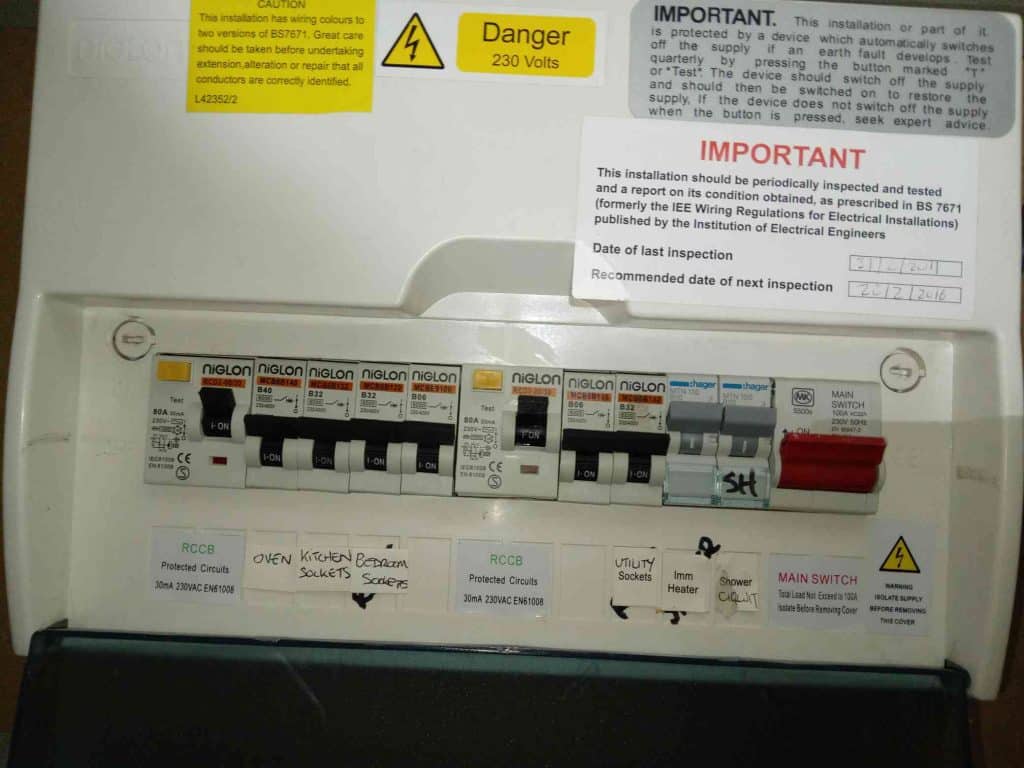
- Incorrect circuit markings on the fuse box and mixed branded MCBs in the fuse box.
Explanation: Branded fuse boxes are designed for their own make of MCBs (circuit breakers – the switchy thing that goes up and down to turn your lights or sockets on or off). When different brands are added to a different fuse box the fitment might not be correct and put strain on the internal components, risking overheating or loose breakers.
All circuits should be marked correctly on the fuse box in case of an emergency and to help electricians identify circuits properly.

- Gaps around the fuse box.
Explanation: fuse boxes contain metal parts that can be rated up to 100amp meaning a shock from that kind of current can immediately kill. Its very important to make sure there are no gaps in the fuse box where fingers can be inserted. Modern units need to have a diaphragm grommet installed on all cable entry points to make sure dust, water or fingers cant be inserted.

- A broken cooker switch in the kitchen held together by blue tape.
Explanation: Accessories such as cooker switches or light switches should be held together by screws to make sure they are secured safely. Because of the live cables behind the switch face its very important to make sure the cables are not accessible to people.
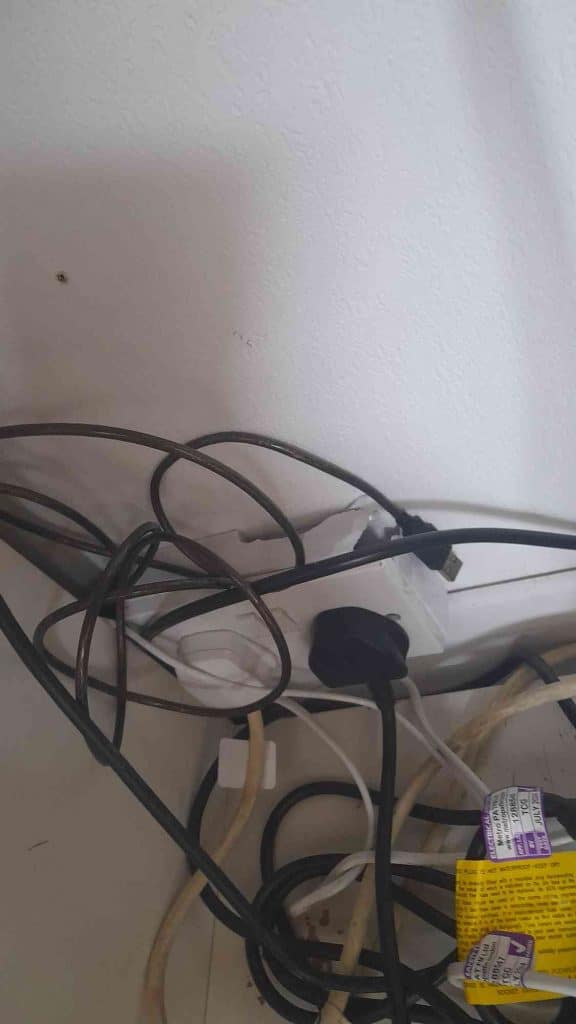
- A broken socket face.
Explanation: Socket faces have high powered cables behind them. Making sure the cables behind are not accessible is vital to prevent electrocution. These visual observations are a main part of EICR testing and inspection.

- Signs of heat damage in the fuse box.
Explanation: There are burn marks on the top neutral bar (marked 7) where there are clear signs of overheating causing a black burn mark. The cable that was in that space has now been removed however it is something we would look into further in order to find out why this had happened.

- Mixed coloured cabling (Red & Black and Blue & Brown) and No continuity on the ring circuit.
Explanation: Red and black cabling has been around since the 1940s and used up until the early 2000s. It doesnt necessarily mean that the cables are unsafe however it is something worth noting on an EICR.
Ring circuits supply plug sockets in a property. Its called a ring circuit because the cable leaves the fuse board, goes around to all of the sockets and then returns back to the fuse box forming a ring or loop. The integrity of that “loop” is important to ensure the right size circuit breaker has been installed. Ring circuits can carry up to 32amp and therefore that should be the maximum limit of the breaker installed for that circuit. On the flip side if the ring has been broken the maximum should be 16amp.

- A broken spur switch missing a fuse.
Explanation: Broken and loose accessories are potentially dangerous and should be noted on the EICR certificate. They will be listed on the EICR as a point that needs addressing and can be rectified within a reasonable time.

- Single insulated main tails.
Explanation: Tails are the main power cables supplying the fuse box. They can be rated to 100amp and need to be double insulated to make sure they cant be damaged easily.

- Cover of trunking missing and exposed single insulated cables.
Explanation: Single insulated cables are categorised as a C2. Single unsulated cables can be spotted around your property by the brown/blue/green/yellow cables. If you can see these it means the outer layer (second insulation) has been removed or stripped. All cables in a property should be double insulated to ensure no exposure or risk to live cables.

- Exposed live cables
Explanation: Any exposed live cables are immediately deemed to be an immediately dangerous situation and need to be discussed wit the responsible person as soon as possible. These kinds of dangerous situations are the worst and need to be rectified immediately.